As an Amazon Associate, KitchenWithMommy.com earns from qualifying purchases.
Children’s tableware comes in a handful of materials, and each is good at something different. Two of them come with official warnings that are worth knowing before you buy.
How we put this together: from manufacturer specifications, published materials information and official guidance. We have not run a comparative test of competing products and don’t claim to have. This is a set of criteria to check, not a ranking.
The materials at a glance
| Material | Good at | Limitations | Microwave? |
|---|---|---|---|
| Food-grade silicone | Flexible, unbreakable, quiet; often has built-in suction | Can stain and hold on to oily smells | Usually yes: check the rating |
| Stainless steel | Almost indestructible; no staining | Noisy when dropped; heavier than plastic | Never |
| Polypropylene (PP) plastic | Light, cheap, rigid | Scratches over time | Only if labelled microwave safe |
| Melamine | Hard, colourful, looks like crockery | Not for heating food | No: see below |
| Bamboo-plastic composite | Marketed as eco-friendly | FSA advises not to use it for food: see below | No |
Melamine: fine for serving, not for heating
The US FDA says food and drinks should not be heated on melamine tableware in a microwave, because heating acidic foods to high temperatures can increase the amount of melamine that migrates out of the plastic. Heat food in a microwave-safe dish and serve it on melamine if you like (FDA melamine Q&A).
Bamboo-plastic: the FSA’s advice is to stop using it
Many “bamboo” children’s plates, bowls and cups are not pure bamboo. They are bamboo fibre mixed with plastic resin. The UK Food Standards Agency explains that these can leak formaldehyde and melamine into food and drink, especially when heated or used with acidic foods. Its advice is not to use them for storing or serving food, and to dispose of any you have at home (FSA). It adds that they are often marketed as biodegradable, but because of the plastic in them they cannot be recycled.
This does not apply to solid wooden bowls, which are a different product, though they are usually hand-wash only.
What the labels tell you
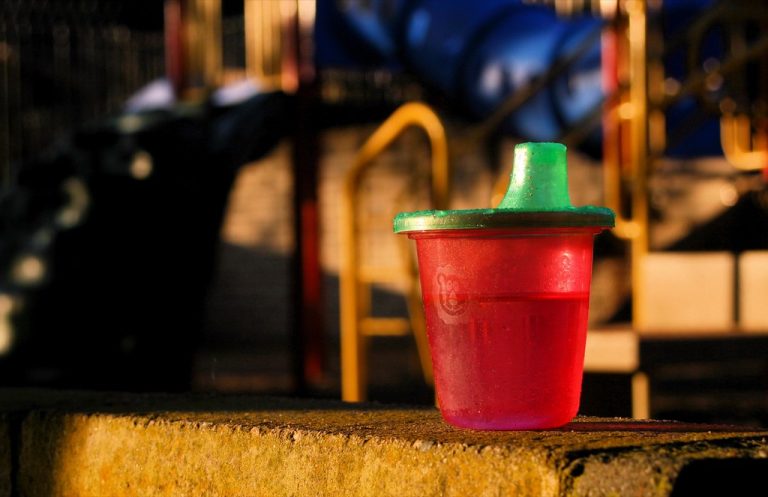
- “BPA-free” is close to universal and tells you little on its own. The FDA’s rules no longer allow BPA-based materials in baby bottles and sippy cups (FDA).
- The named material (food-grade silicone, PP, 18/8 stainless steel) is more useful than any “non-toxic” claim.
- Microwave and dishwasher ratings are the practical information. “Dishwasher safe” often means top rack only.
So which should you buy?
For most families: silicone or polypropylene for everyday meals and reheating (if rated), stainless steel for durability, and melamine only for serving. Skip bamboo-plastic composites. For suction, divider height and matching plates to your child’s stage, see how to choose toddler plates and bowls.